Pressure cookers
Pressure cookers for dal, rice and curries. Compared on capacity, aluminium or steel body, induction base and safety valves.
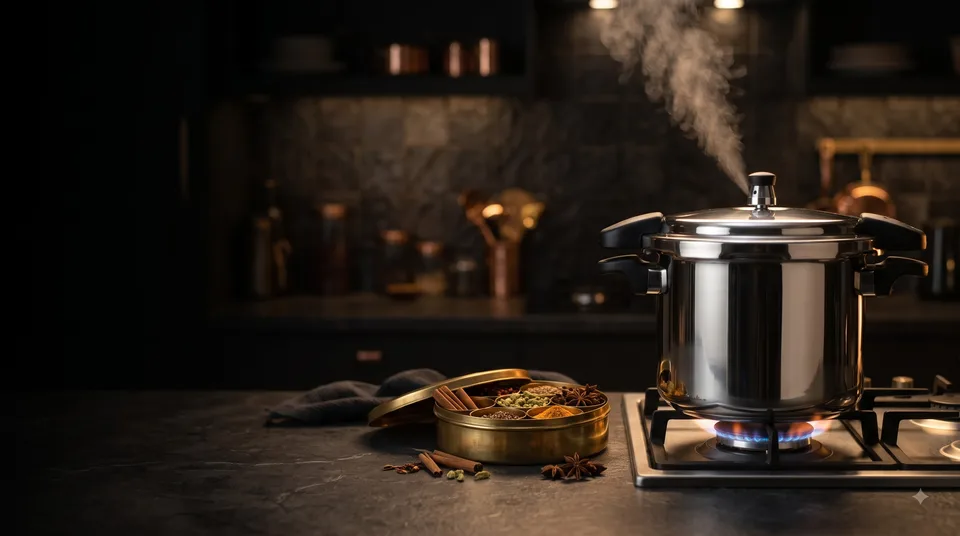
How to choose a pressure cooker
People buying a pressure cooker usually weigh an aluminium body against steel, then check the base for induction use. Hawkins says its cookers work at 121°C and 15 psi. It claims pressure cooking can cut normal cooking times by as much as half.
That suits dal, rice and curries cooked daily. Capacity then follows your household size.
Start with the best pressure cooker and the best stainless steel pressure cooker. Size guides cover the best small pressure cooker, the best mid-size pressure cooker and the best large pressure cooker. Other pages cover the best induction pressure cooker, the best electric pressure cooker and the best Prestige pressure cooker.
Body material comes first. IS 2347 allows specified aluminium grades or specified stainless steel grades for the body and lid. An aluminium cooker meant for induction needs a plate of 430 or 439 series stainless steel. A tri-ply cooker needs a grade 304 inner layer, an aluminium middle and a 430 or 439 outer layer.
Hawkins says only certain models work on induction, such as its stainless steel, Hevibase and some Futura cookers. All its cookers suit domestic gas stoves.
Safety parts need attention. Hawkins advises checking that the vent tube, vent weight and safety valve are clear before closing the lid. It recommends replacing the safety valve after one year of everyday use. It also advises replacing the rubber sealing ring once it stops sealing or turns hard or cracked.
Aluminium has one limit. Hawkins says deep-frying, or frying beyond 20 minutes at a stretch, can weaken an aluminium or anodised body and make it unsafe.
All pressure cooker guides
Pressure cooker questions
How full can I fill it?
Hawkins says never to fill beyond two thirds. Use half for foods that expand, such as rice and lentils. Use one third for dals that sprout, such as tuvar and moong.
How much water is needed?
For 1.5 to 3 litre cookers, Hawkins advises at least 240 ml for the first 10 minutes plus 120 ml for each further 10 minutes. Models of 3.5 to 6 litres start at 360 ml.
Should I count whistles?
Hawkins says counting can give the wrong time and lead to burnt food or a fused safety valve. It advises timing from the point the cooker reaches full pressure.
How do I clean it?
Keep it out of the dishwasher. Salted or acidic liquids can cause pitting, and aluminium can pit if left wet. BIS notes that domestic pressure cookers are under mandatory certification.