Ovens (OTG and microwave)
OTGs, solo, grill and convection microwaves. Compared on capacity, heating modes, power and what you can actually cook in them.
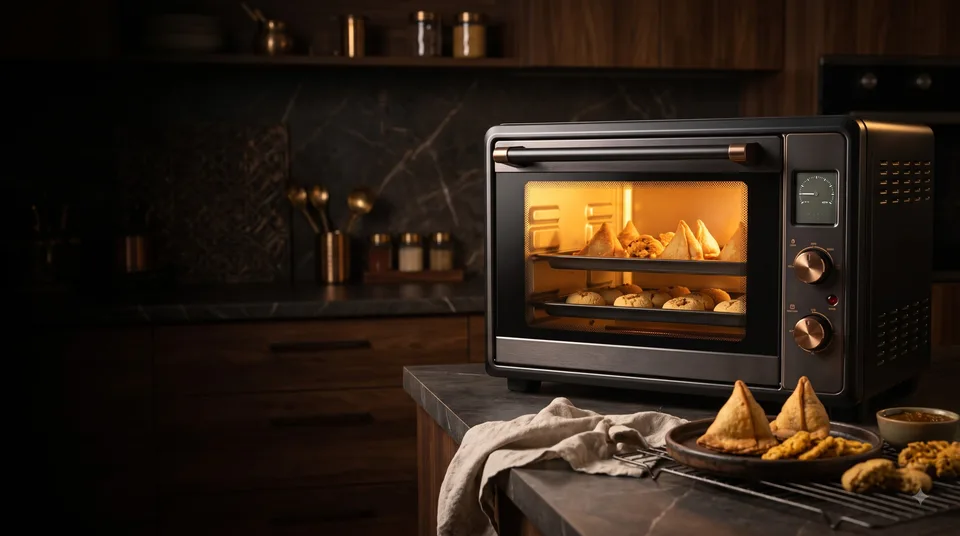
How to choose an oven
Shoppers for an oven are choosing between an OTG, a solo microwave and a convection microwave. Borosil says an OTG suits baking, grilling and toasting. A solo microwave suits reheating, defrosting and quick cooking. A convection microwave adds a fan and heating element, so it can bake and grill as well.
Your menu decides the pick. A cake lover leans to the OTG or convection type. Someone who mostly warms leftovers needs only a solo.
Open the best microwave oven and best microwave oven brand pages first. Type guides cover the best solo microwave oven, the best convection microwave oven and the best OTG oven. Others cover the best microwave oven for home use, the compact solo microwave ovens and the best LG microwave oven.
Capacity and power differ by type. Borosil gives these typical ranges:
| Type | Capacity | Power draw |
|---|---|---|
| OTG | 9 to 60 litres | 1,000 to 1,500 W |
| Solo microwave | 15 to 32 litres | 700 to 1,200 W |
| Convection microwave | 20 to 32 litres | 900 to 1,400 W |
Borosil notes that OTGs run for longer. Preheating also differs. An OTG needs about 10 to 15 minutes. A solo microwave needs none for most tasks. A convection model needs about 5 to 8 minutes in baking mode.
Microwaves make water molecules in food vibrate, and that makes heat. In thick foods, the centre cooks mostly from heat conducted inward from the outer layers.
Cookware needs thought. The US FDA advises using cookware made for microwave ovens. Metal pans and foil can cook unevenly and may damage the oven. Some plastics can melt. Borosil adds that not all borosilicate glassware is microwave-safe.
All oven and OTG guides
Oven and OTG questions
Which standard covers microwave ovens?
IS 11676 covers household microwave ovens on single-phase AC up to 250 V. They must meet the safety clauses of IS 302-2-25. Leakage must stay under 5 mW/cm² at 5 cm from the oven in normal use.
What should I check on the door?
The US FDA advises against using an oven whose door does not close firmly or is bent, warped or damaged. Stop at once if it runs with the door open.
Is it safe to heat water for tea?
Water can become superheated without visibly boiling and then erupt when disturbed. Do not heat liquids longer than the oven manual recommends.
Does the stated power match the real output?
Under IS 11676, the usable cavity volume, shelf area and microwave power output must be within 10 per cent of the declared values either way.